 Veresimo
Articles8 November 2026, 3 min read
How to track your monthly spending: a simple household budget
"Payday was last week; where did it go?" The answer is in writing your spending down. A simple household budget with a few categories and a few seconds a day.

Checking your account on the twentieth and wondering where the money went is very common. Usually the answer isn't the big purchases but the small everyday ones: a coffee, a takeaway, a few extra things in the supermarket basket. Each looks trivial; added up at the end of the month, they are a big part of the budget.
Tracking spending isn't about restricting yourself. It's about seeing where the money goes, because you can't decide without seeing.
1. Pick a few meaningful categories
A budget that starts with twenty categories is abandoned by week two. Around ten is enough:
- Groceries
- Eating out
- Rent and building fees
- Bills (electricity, water, gas, internet, phone)
- Transport and fuel
- Clothing
- Health
- Education
- Fun and subscriptions
- Home
On the income side, a few headings such as salary, side income and rental income are enough.
2. Write it down when you spend
Trying to remember at the end of the month doesn't work; small purchases get forgotten. The best moment is right when you spend: leaving the till, putting the card away. On a phone it takes seconds.
If you get a receipt, taking a photo and recording it straight away works better than keeping the paper. Receipts get lost in wallets; photos don't.
3. Separate card and cash
Card spending shows up on your bank statement later; cash leaves no trace. Writing down cash spending matters most. If you mark each entry as card or cash, you see both totals at the end of the month.
4. At the end of the month, answer three questions
Take ten minutes on the last day of the month:
- How much is left? Income minus spending. If it's negative, finding out why comes first.
- What are the three biggest categories? Fixed costs like rent are always big; the interesting ones are the variable costs. Are eating out or subscriptions higher than you thought?
- What changed since last month? One month can mislead. Put two or three side by side and a steadily rising item stands out.
5. Set a simple goal
After a month or two of tracking, set your first goal. A common starting point is to put roughly half of your income towards essentials (rent, bills, groceries, transport), about a third towards things you choose to spend on, and the rest towards savings. The split won't suit everyone; what matters is having a goal and seeing how close you get each month.
Starting with one category is easier: "This month, I'll spend 500 lira less on eating out than last month."
6. Look at the whole year
Some costs come once a year or by season: school costs, higher gas bills in winter, holiday shopping, car insurance. Seeing twelve months side by side helps you spot these and get ready a few months ahead.
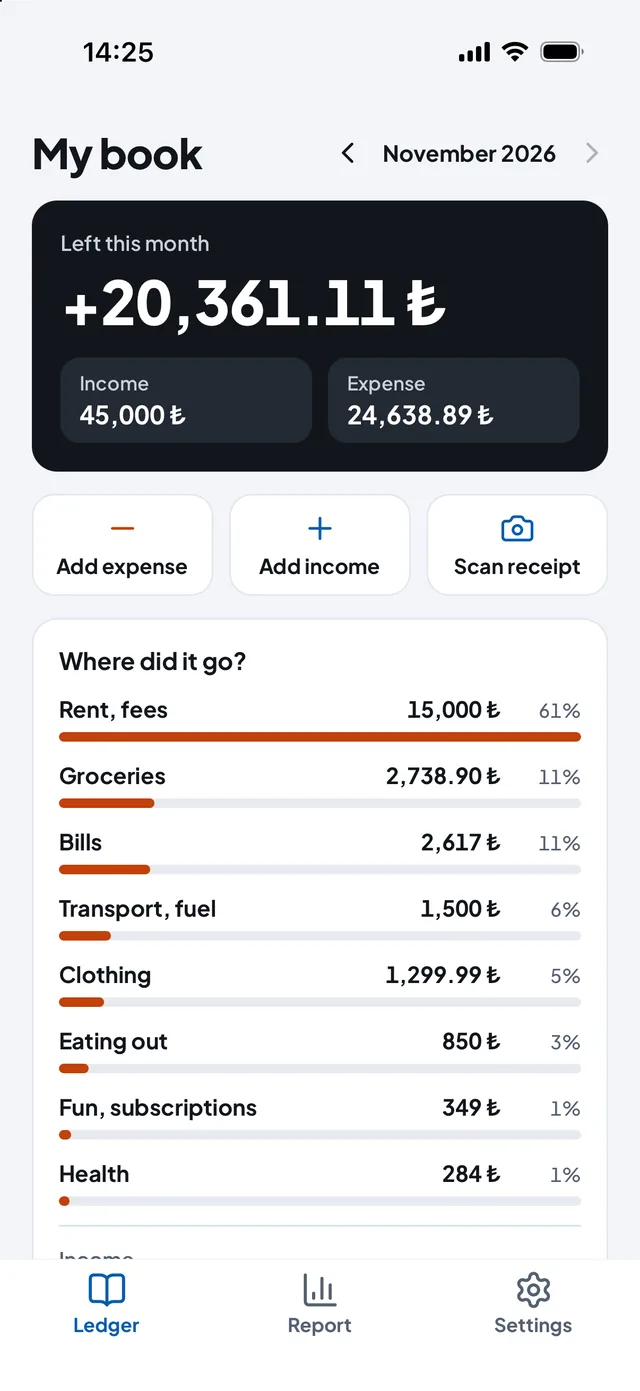
Veresimo's personal book was made for this: tap Add expense when you spend and Add income when your salary comes in; this month's income, spending, what's left and a "Where did it go?" breakdown sit on one screen. The Report tab shows the twelve months of the year side by side. The book, the report and backups are free; with Pro, taking a photo of a receipt fills in the amount, date and shop for you. There's no account to open and your records stay on your phone. See the Help page for details.
In short
- Around ten categories is enough.
- Write it down when you spend; photograph receipts.
- Don't forget cash.
- At month end: what's left, the three biggest categories, and the change since last month.
- Set one small goal in one category.