 Veresimo
Articles8 November 2026, 4 min read
How to remind customers who owe you: polite, normal and firm message examples
Asking for money is the part of the job no shopkeeper likes. When to send a reminder, which tone to use, and ready-made WhatsApp messages you can adapt.

Handing over goods is easy; asking for the money is hard. Many shopkeepers put off reminders so as not to seem rude, and meanwhile the debt grows and asking gets harder. A reminder sent at the right time, in the right tone, rarely offends. Most customers have simply forgotten, and are glad to be reminded.
When to send a reminder
On the due date or the day after. If they said "end of the month", send it on the first; if they said "Friday", send it Friday morning. Reminding on the promised day feels natural, because they remember their own promise.
If there's no due date, after two weeks. That's a reasonable wait for a debt with no date.
In the morning or early afternoon. A debt message late at night or very early feels intrusive, however polite it is.
Which tone?
Not every customer should get the same message. Writing the same sentence to someone who has paid on time for years and to someone you haven't seen in three months is unfair to both. Think in three tones:
- Polite: a first reminder, or for customers who usually pay on time.
- Normal: a second reminder, or a debt that is a little overdue.
- Firm: a debt that has had several reminders and no reply.
Always use their name, state the amount clearly and make paying easy. A vague "you have an account with us" causes more arguments than a message with the figure in it.
Message examples
Adapt these to your shop and fill in the parts in brackets.
Polite
Hi [Ahmet], hope you're well. Your account at [Bereket Market] shows [1,250 lira]. Whenever it suits you, drop by or send a transfer. IBAN: [TR00 0000 0000 0000 0000 0000 00], account name: [Mehmet Yilmaz]. Have a nice day.
Normal
Hi [Ahmet], your account at [Bereket Market] has a balance of [1,250 lira]; your last payment was on [12 October]. We'd be grateful if you could pay it this week. IBAN: [TR00 ...], account name: [Mehmet Yilmaz]. Thank you.
Firm
Hi [Ahmet], the [1,250 lira] on your account at [Bereket Market] has been overdue for [20 days], and we haven't heard back from our earlier reminders. Please settle it by [Friday]; until then we can't add any more on credit. IBAN: [TR00 ...], account name: [Mehmet Yilmaz].
Even the firm tone has no insults, threats or public shaming. Posting a debt in a group, to the customer's family or on social media ends the relationship and can cause you trouble. The message goes to the person who owes, and no one else.
Make paying easy
The point of a reminder is getting paid. If the customer can pay the moment they read it, they are much more likely to:
- Put your IBAN and account name in the message. For bank transfers the name has to match the account holder.
- Be open to part payments. Saying yes to "half this week, the rest next week" beats getting nothing.
- Send a statement. If the customer questions the amount, a one-page list of what they bought and when ends the argument.
When they promise, write it down
If the customer says "I'll pay Friday", note it and remind them on Friday morning. Following up on a promise works better than a fresh reminder: "You mentioned Friday; will you be able to drop by today?"
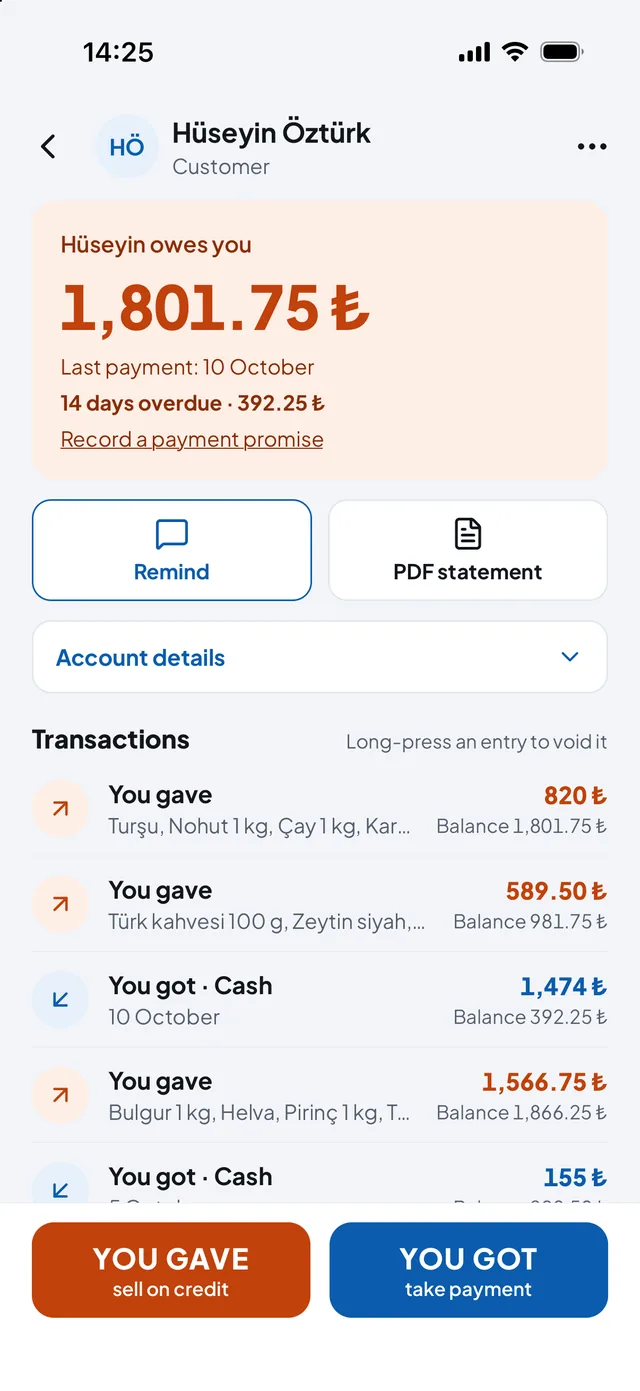
In Veresimo most of this is one tap: on the customer page, tap Remind and a ready message in the tone you picked (polite, normal or firm) opens in WhatsApp with your IBAN; you just press send. If the customer gives a day, Record a payment promise and you get a notification that morning. PDF statement sends what they bought and when on one page. The Help page shows how, step by step.
In short
- Remind on the due date; with no date, wait two weeks.
- Pick a tone for the customer: polite, normal or firm.
- Name and amount, clearly; add your IBAN.
- The message goes only to the person who owes; no threats, no shaming.
- When they promise a day, note it and remind them then.