 Veresimo
Articles8 November 2026, 4 min read
How to keep a credit book for your shop
Who gets credit and how much, what to write on each line, how to record a payment. The rules neighbourhood shops have used for years, and what to watch for when moving to your phone.

Selling on credit is how a neighbourhood shop builds trust. The teacher waiting for payday, the builder paid on Fridays, the neighbour who says "I'll bring it tonight": giving them goods keeps the shop going. But a badly kept book is the fastest way to lose that trust: a forgotten line, a figure no one can read, an argument over "I already paid that".
Whether you keep your credit book on paper or on your phone, these rules will help.
1. Give every customer their own page
The most common mistake is keeping the book in date order. To find one customer's total you have to flip back through the pages. Give each customer their own page (or their own contact on your phone), with only what they bought and paid.
Write their phone number next to their name. When you need to send a reminder, you won't have to look for it.
2. Write the same four things on every line
- Date: when did they buy?
- What: a short note like "bread, cheese, detergent". This is the line that settles arguments.
- Amount: one clear figure.
- New balance: what they owe in total after this entry.
Most paper books skip the last column, so you have to add everything up again each time. Write the balance on every line and the answer is ready when the customer asks.
3. Don't cross out payments; add a new line
When a customer pays part of what they owe, it's tempting to cross out old lines. Don't. Write the payment as a new line ("15 November, paid 500") with the new balance under it. Crossed-out entries damage trust on both sides; a payment on its own line shows the history as it happened.
If you make a mistake, cancel it rather than erasing it: add a line saying it was entered by mistake, with the opposite amount. Most phone apps do this for you.
4. Set a limit for everyone
Credit problems rarely start with one big debt. They start with small amounts that slowly pile up. Have a limit in mind for each customer, and when someone gets close to it, talk about the old balance before adding more.
Starting new customers with small amounts and raising the limit for those who pay on time works well.
5. Ask for a due date and note it
"End of the month", "when my salary comes in", "I'll drop by on Friday". Write down the day the customer gives you. A debt with no date is the one that takes longest to be paid. When the day comes, a polite reminder is usually enough.
For large amounts or long terms, a written document such as a promissory note can prevent disputes later.
6. Go through the book once a week
Pick a quiet hour, say Monday morning, and check:
- Who is overdue?
- Who hasn't paid anything for a month?
- How much is owed to you in total?
The last one matters. Money owed to you is money that is yours but not in the till. If it grows every week, credit is squeezing your cash.
7. Keep what you owe suppliers in the same place
Keep what customers owe you on one side and what you owe suppliers on the other. Seeing when and how much you owe the wholesaler, the baker and the milkman in one place helps you plan the cash in the drawer.
Moving from paper to your phone
The hardest part of a paper book is the sums: adding up, flipping pages, deciphering figures. A book on your phone does that for you; the balance updates with every entry and overdue customers are shown separately.
Don't re-enter old entries one by one. Enter each customer's balance today as an opening balance and carry on from there. Keep the paper book for a while in case someone asks about an old item.
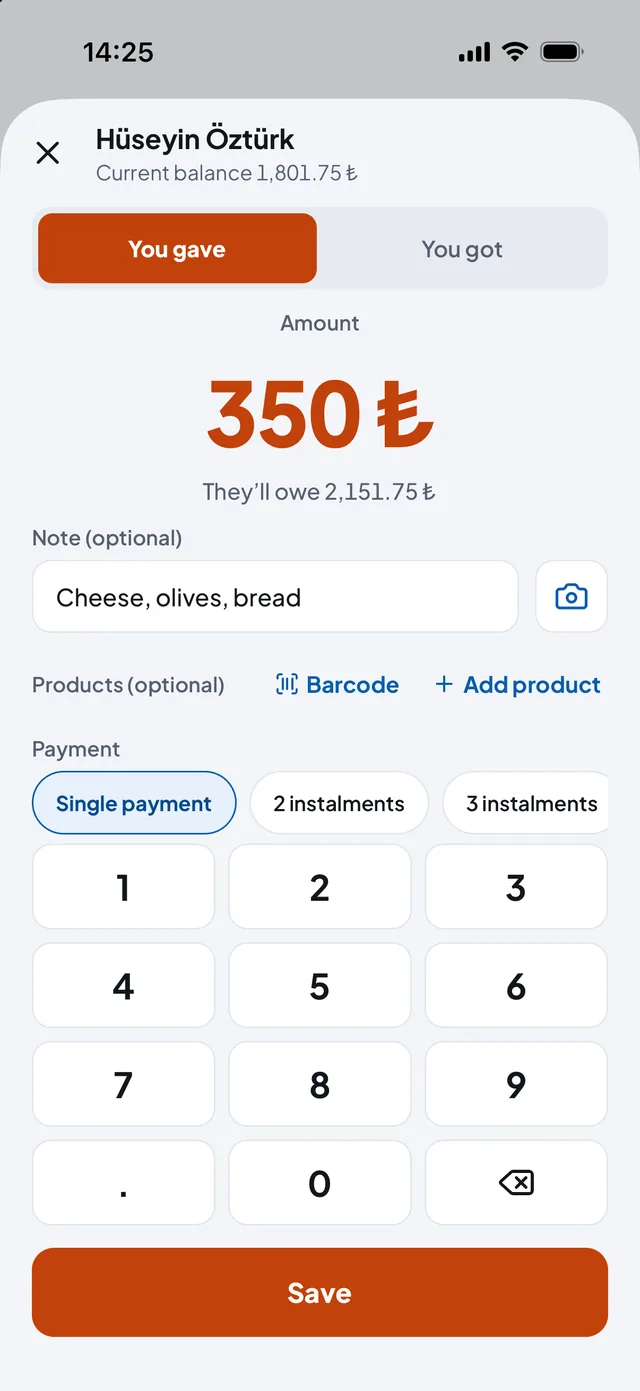
Veresimo was made for this: tap You gave when a customer buys on credit and You got when they pay; the balance, last payment and overdue amount are worked out for you. You can bring in your paper customers with today's balances on one screen. The book is free, there's no account to open and your records stay on your phone. See the Help page for step-by-step instructions.
In short
- One page per customer; date, what, amount and new balance on every line.
- Don't erase payments; add them as new lines and cancel mistakes.
- A limit for everyone, a due date for every debt.
- Check what's owed to you once a week.